The ten-minute pitch · 1 of 10

Sign up your school

FledgePath for schools

Every student at your school, with a plan.

A crew of AI guides that interviews each student, draws their road to college, and keeps them moving — built on what your school actually offers.

Free for schools. Free for students and families.
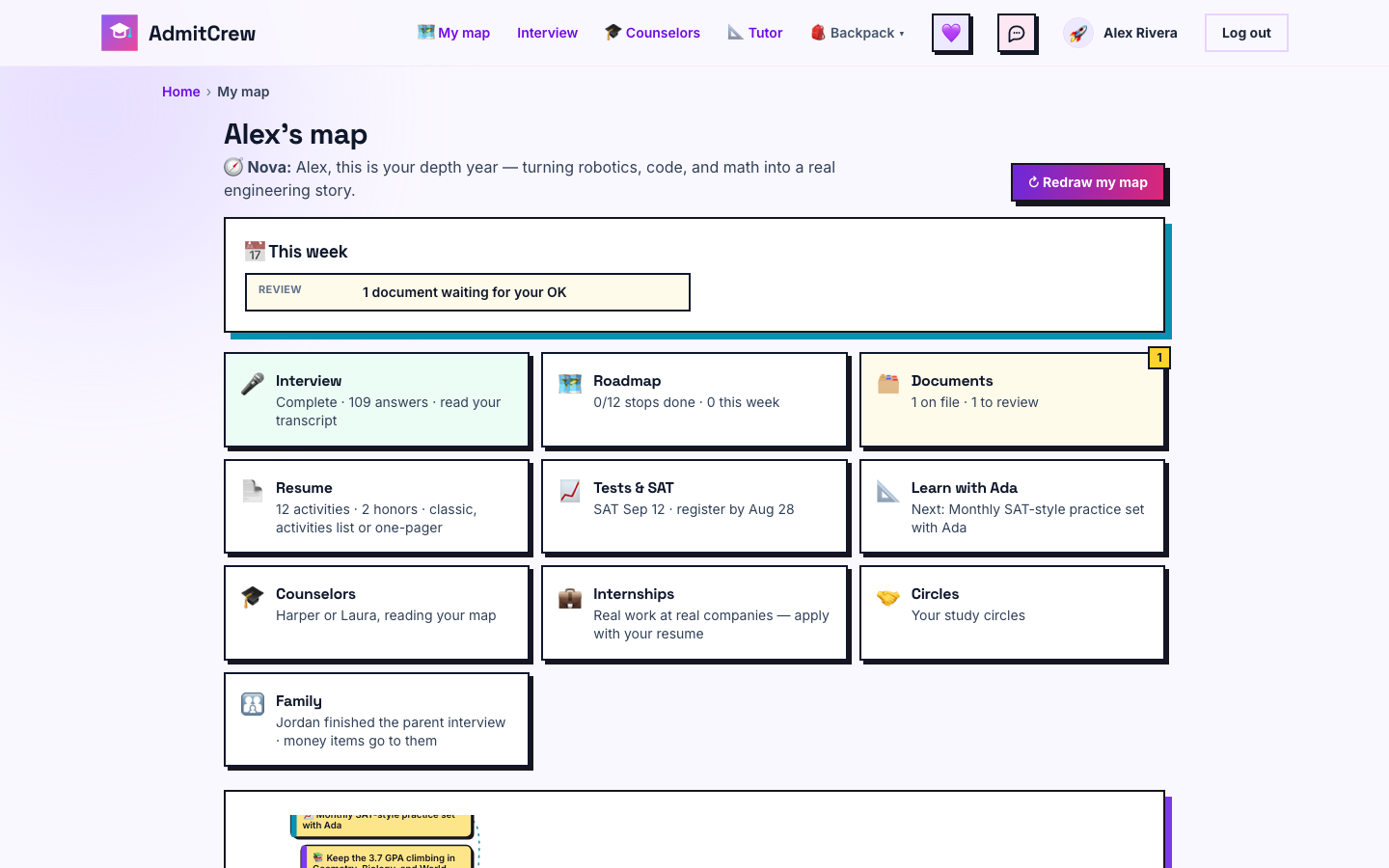
A student's map on FledgePath

The problem

One counselor, hundreds of students, and families guessing.

The national student-to-counselor ratio is roughly 385 to 1 against a recommended 250 to 1. Most planning conversations never happen. Families piece the road together from forums, rumours and older siblings — and the same twenty questions land in your office every week.

  • Which classes matter for what I want to do?
  • When is the PSAT, and does it count?
  • What does this school actually offer — and what does it cost us?
  • Is my kid on track? What should we be doing this month?

What students get

A map of their own, kept current.

It starts with an interview — voice, chat or a form — about classes, activities, dreams and worries. Nova, the planner, turns it into a road through the year with stops that are theirs. Reminders arrive on the channels they use. Ada tutors on a board; Harper and Laura counsel from the map; a resume writes itself from verified facts; local internships and small circles come later.

Nothing is graded. Nothing is sold. Every answer is a fact on the student's own map.
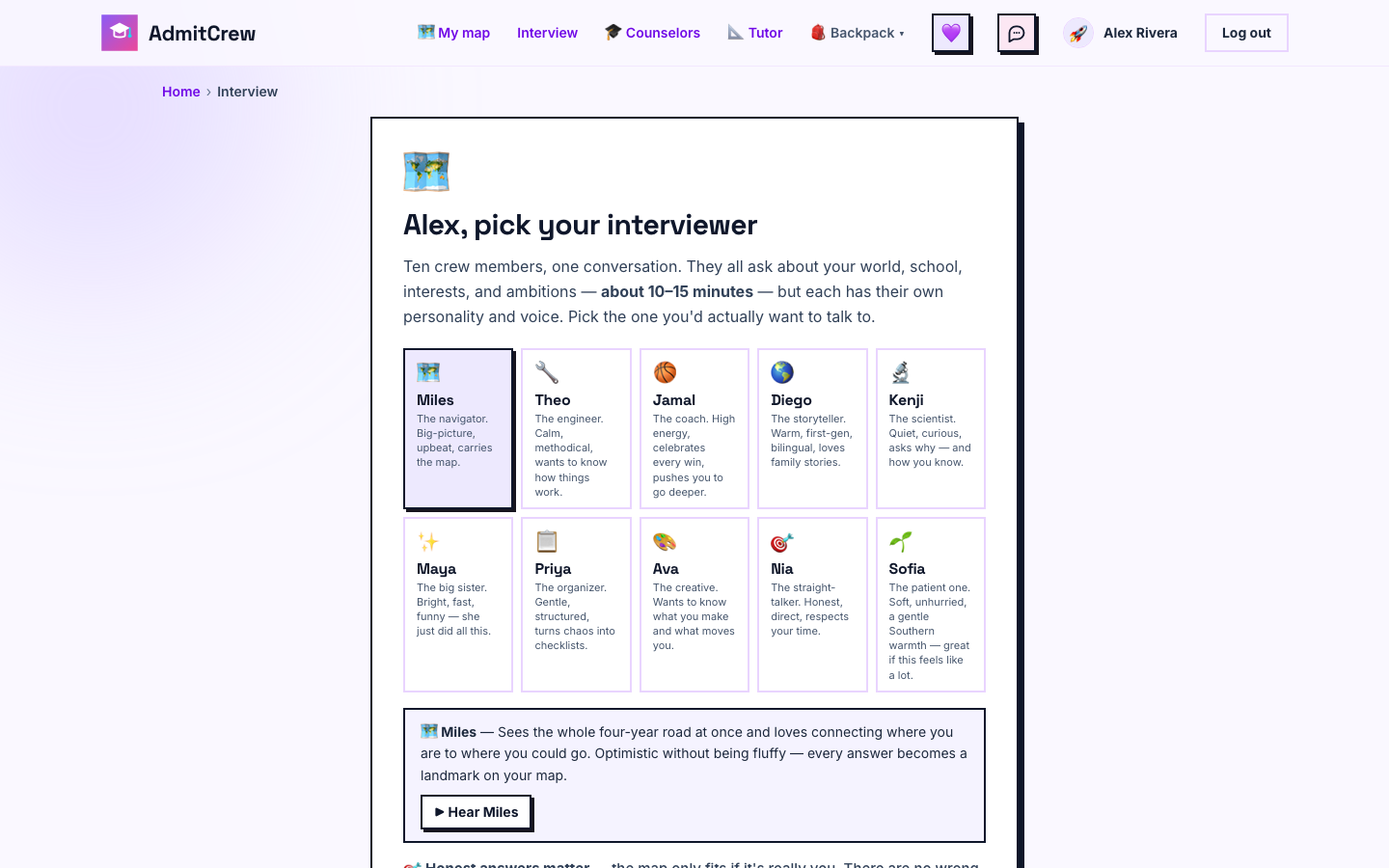
The interview screen

What parents get

Their own interview, and the parts that are theirs to carry.

A parent answers questions about budget, distance and expectations — privately, used only to shape the student's plan. Their Family page shows milestones and the money items routed to a parent. The student decides what else a parent may see.
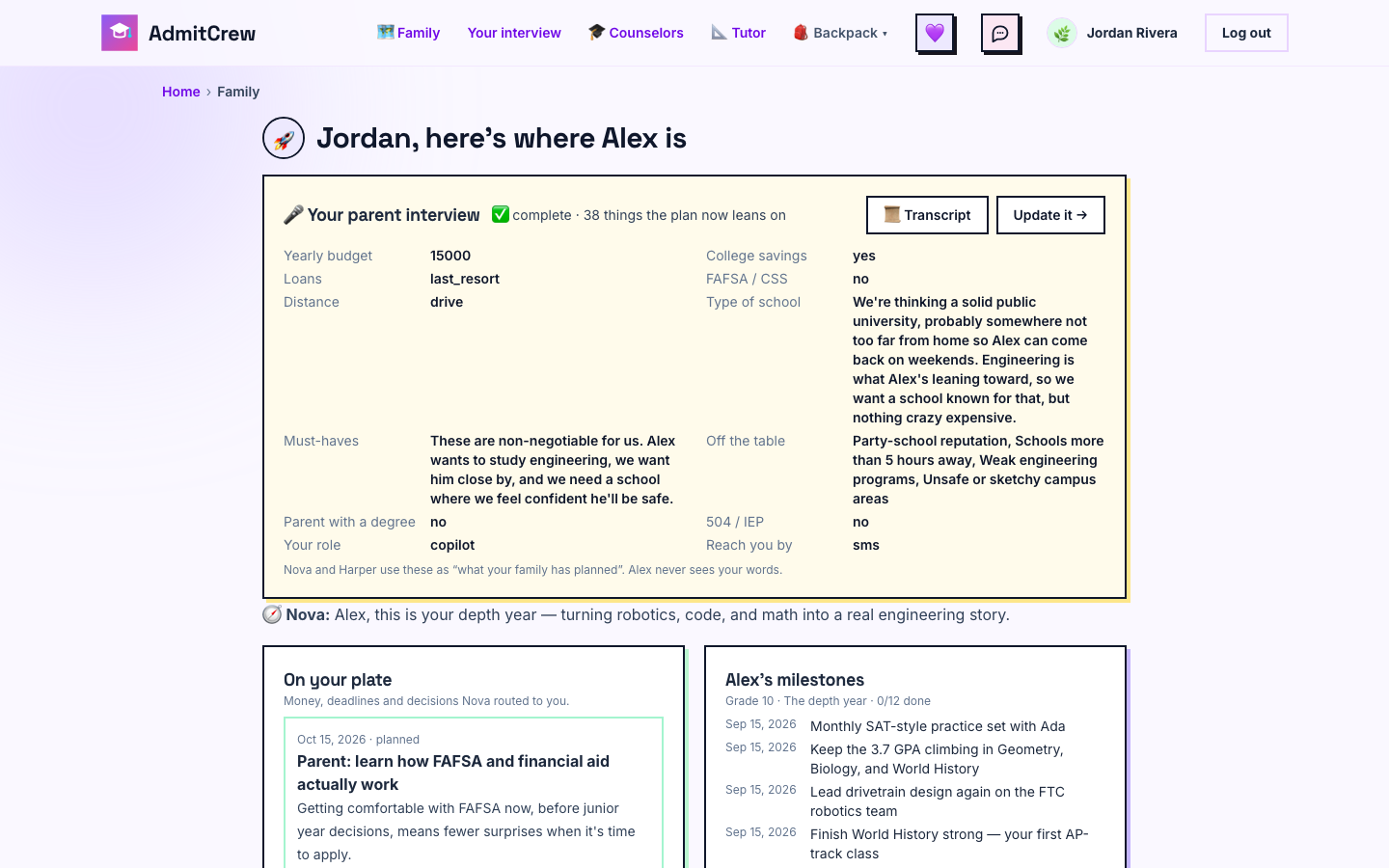
A parent's Family page

What the school gives

One profile, about twenty minutes, once a year.

A counselor signs up with a school email and confirms what the school offers: the AP list (pre-filled from what the school reported federally), the honors path, typical courses per grade, clubs, sports, counselor ratio and key dates. Everything confirmed becomes a verified fact.

From then on the crew stops guessing about your school. Miles asks the right questions, Harper recommends real courses, Nova plans around your calendar — for every student who attends.
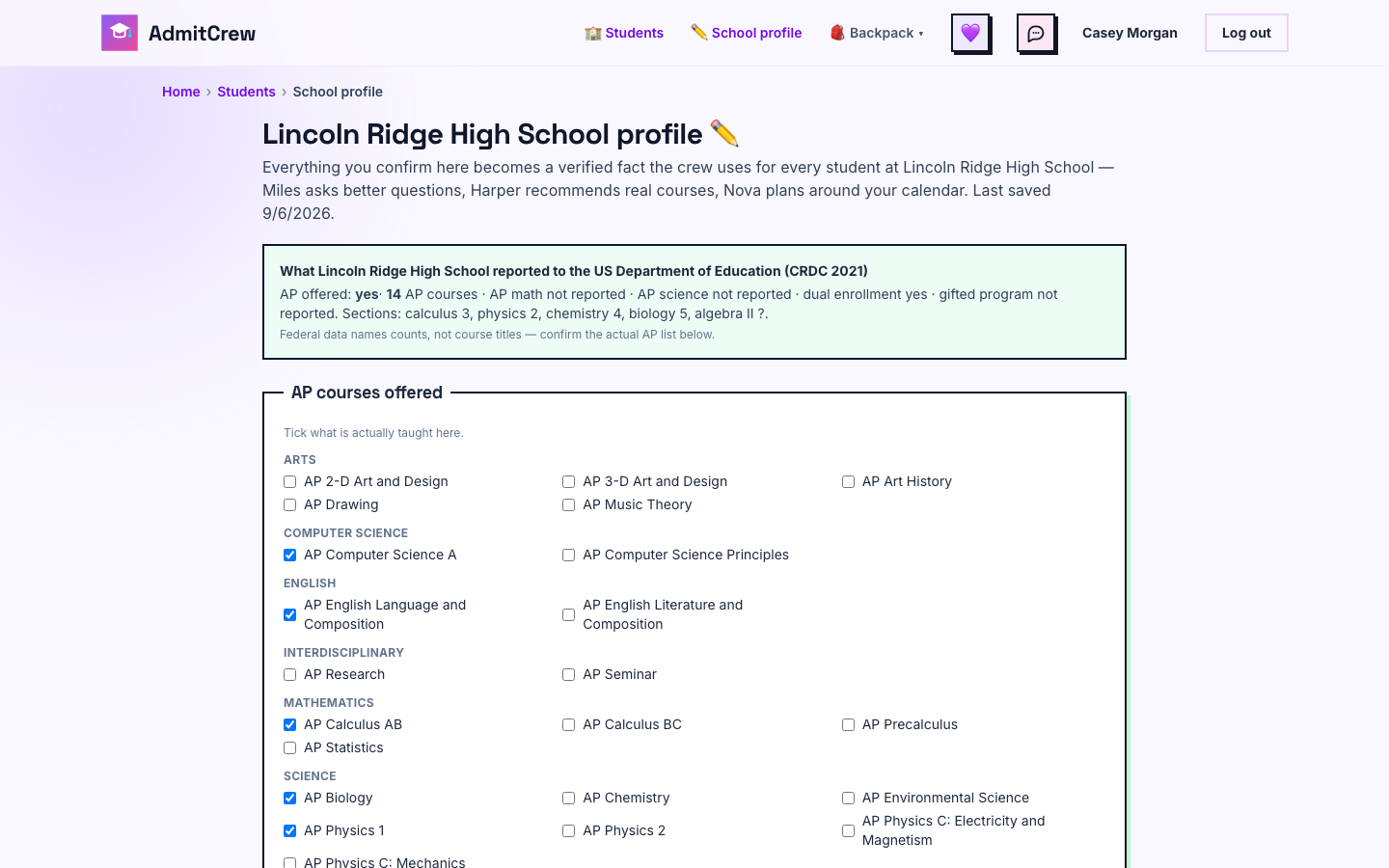
The school profile form

What the school gets back

A dashboard of the students who chose to share, and quieter mornings.

Interview status, map progress, overdue stops, open reminders, documents on file — by grade, exportable, with a one-click nudge that reaches the student on their own channels. Never the conversation.

The repeat questions get answered before they reach you. Your AP list reaches every family. And you see, in aggregate, where students stall.
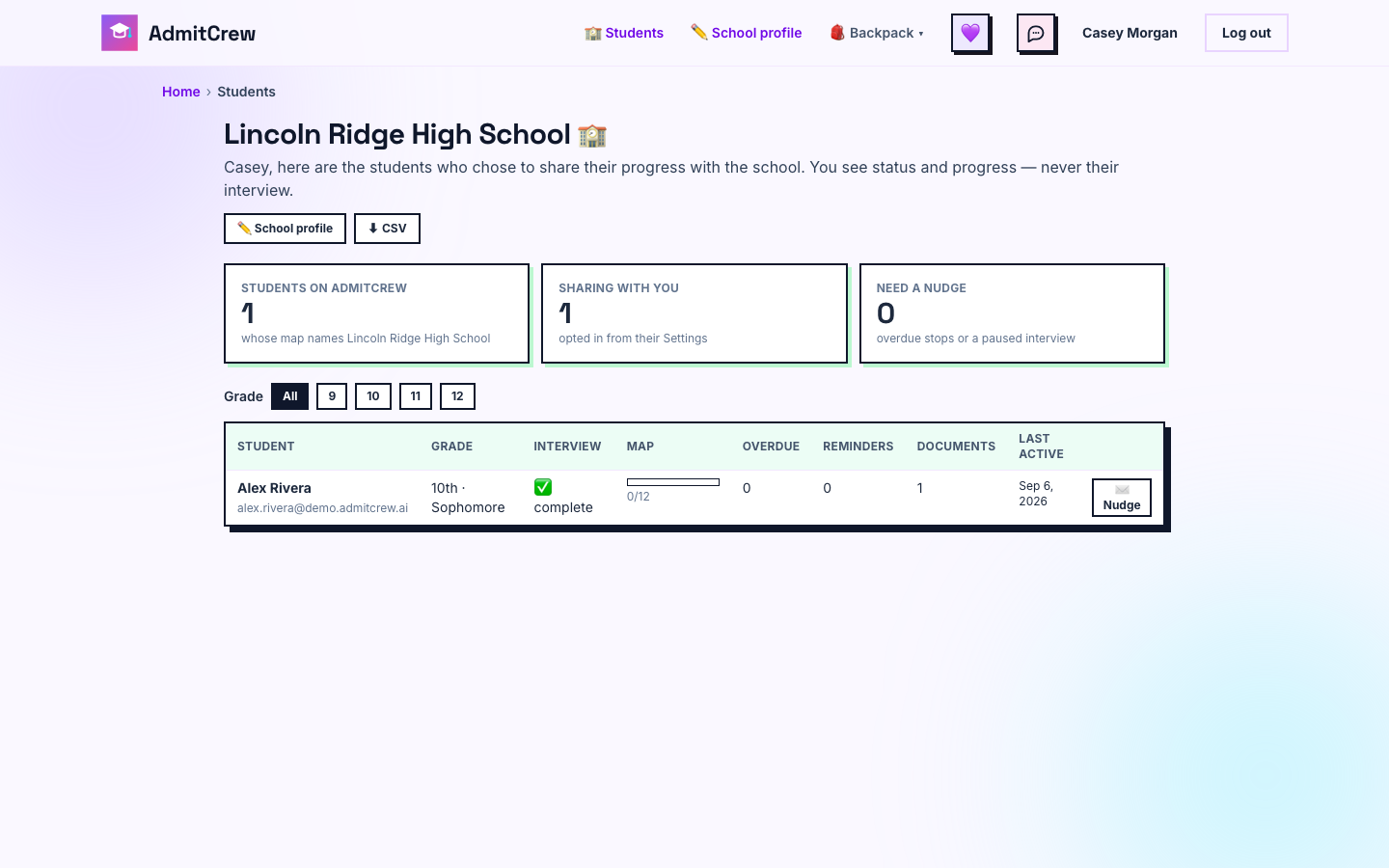
The counselor dashboard

Privacy and consent, in plain words

Students own their map. Sharing is a choice.

  • Sharing with the school is off until the student turns it on. Under 13, a parent must also say yes.
  • Counselors see status and progress — never transcripts, never conversations.
  • Parents see what the student allows; under-13 transcripts are shared with parents by default.
  • Every conversation runs through guardrails; a crisis message gets the 988 line, not a chatbot.
  • Data is used to advise the student. It is never sold and never used for ads. Accounts and data are deleted on request.
  • Age is asked at signup; the product is built for 13 to 18 with parent consent flows for younger students.

Where the facts come from

Said, proven, and verified — kept apart.

What a student says is kept separate from what a document proves and from what a verified source states. The crew reasons over all three and says which is which.

  • Public sources: NCES school directory and CIP majors, College Scorecard, O*NET careers, BLS outlook, federal course-offering data (CRDC), SAT and ACT calendars, state aid programs, open textbooks under open licences.
  • Every model call is traced and costed; an automated QA suite exercises the whole product against production every week.
  • Voice is optional and always user-initiated. Typing works everywhere.

Cost and effort

Free. Five minutes to verify, twenty to fill in, nothing to install.

Schools pay nothing. Students and families pay nothing. The project is supported by families who choose to chip in. There is no premium tier that changes what a student gets.

  • Verification: a school-domain email plus the public school directory. Private schools are approved by a person within a day.
  • Profile: one form, editable any time.
  • Students join on their own; the school never manages accounts.

Next step

Sign up your school today.

fledgepath.ai/school/signup — pick your school, use your school email, enter the code, confirm the profile.

Questions: hello@fledgepath.ai. Want to see it first? The narrated demo walks through a sample family in ten minutes.
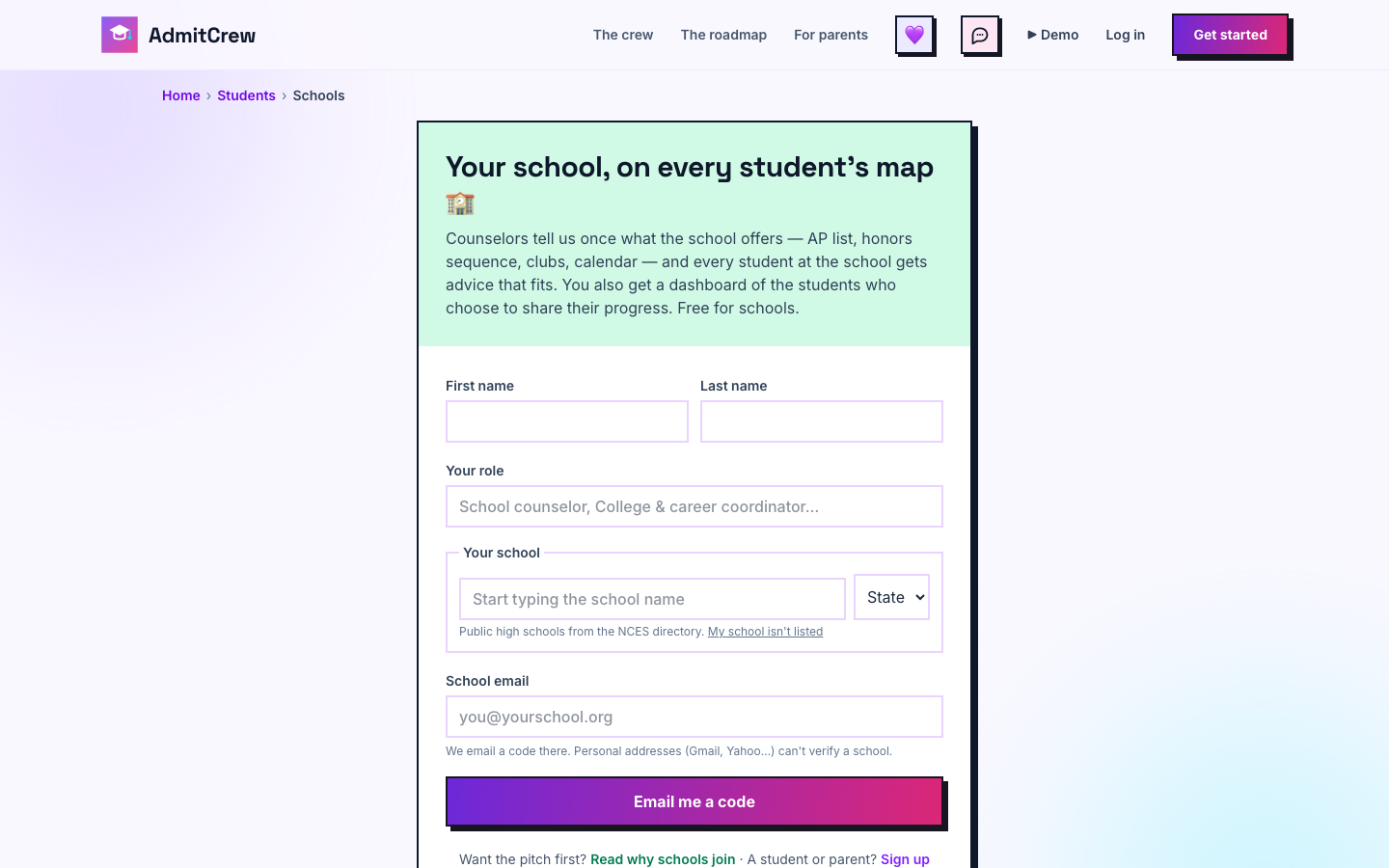
The school signup page

Arrow keys to move; space pauses the pitch. Screens are from the live product with a sample family. Prefer a video to forward? Open the narrated video.